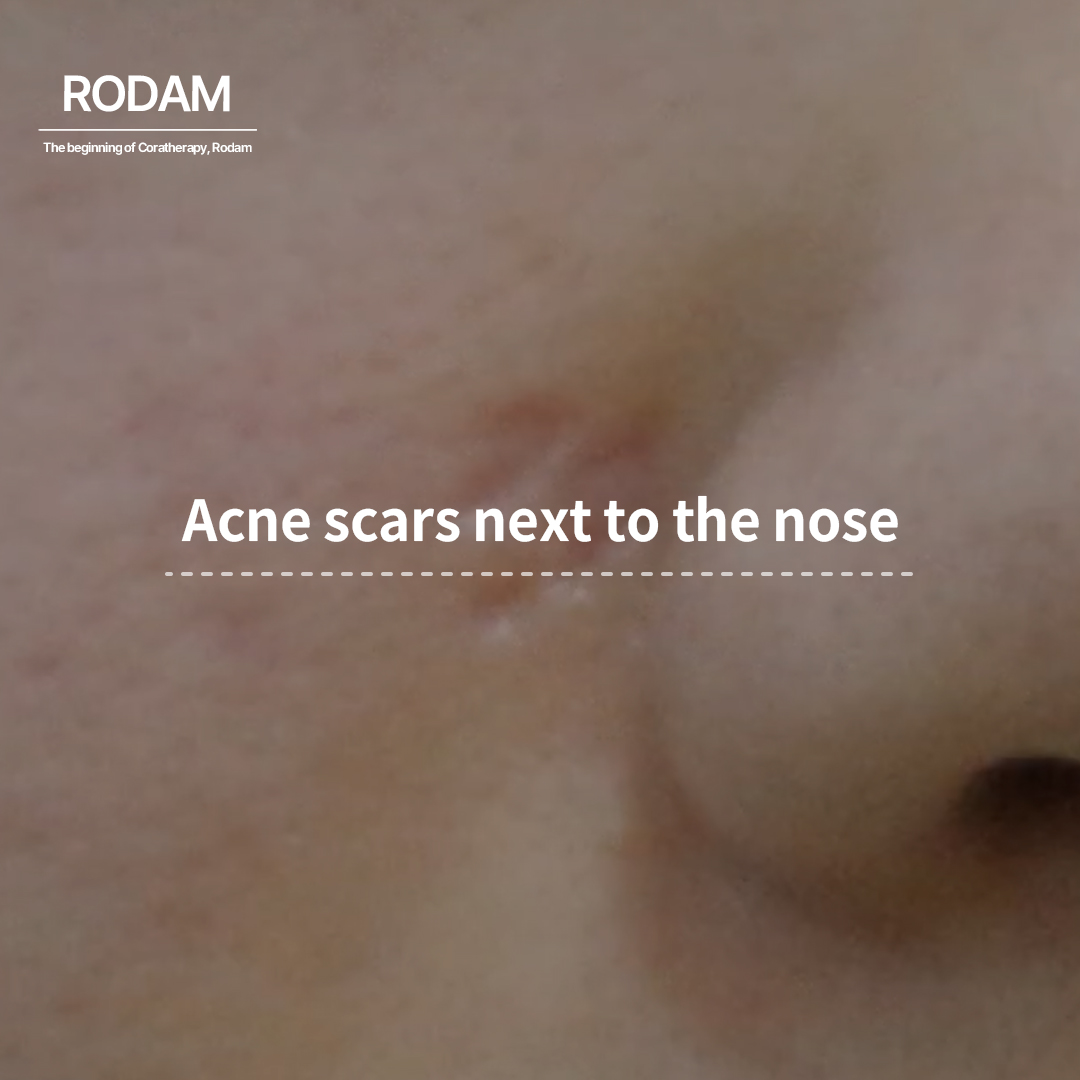
Acne scars next to the nose removal? Rodam Korean Medicine Clinic Coratherapy treatment!
Hello, this is Rodam Korean Medicine Clinic, the beginning of Coratherapy for scar removal.
If acne on the face is not properly managed, it can easily lead to scars.
In particular, if a depressed scar forms next to the nose, it can be difficult to treat.
This is due to the skin structure and characteristics near the nose, which has many sebaceous glands, thin skin,
and is located directly above the cartilage, making post-inflammatory scars deeper and more likely to remain.
For this reason, general skin regeneration treatments are not well-suited, and a fundamental treatment method that restores the dermal layer of the skin is necessary.
In such cases, Rodam Korean Medicine Clinic’s Coratherapy for the nose is the solution.
We would like to explain why even depressed scars next to the nose can be treated and recovered with Coratherapy
through an actual case study.

Case :: Depressed acne scars next to the nose
History :: Tried multiple procedures but saw no improvement
Report :: 6 sessions of Coratherapy completed (10 sessions initially planned)
Today’s case involves a female patient in her 20s.
This patient had narrow pores and well-maintained oil and moisture balance, resulting in overall excellent skin condition.
However, this made the scar next to her nose stand out even more.
The scar was caused by inflammatory acne 1-2 years ago,
and its location near the center of the face, next to the nose, caused significant stress.
The patient tried various treatments to improve it but saw no results,
and chose Coratherapy as a last hope.
The scar was wide and deep, located in an area with active sebaceous gland activity.
Thus, a treatment plan was set to perform a total of 10 sessions of Coratherapy.
After the third session and before the fourth session, the photos show that the deep scar had become generally smoother.
As mentioned earlier, due to the active sebaceous gland activity in the area next to the nose, sebaceous plugs were visible,
but these were safely removed during the fourth session to prevent the development of secondary scars.
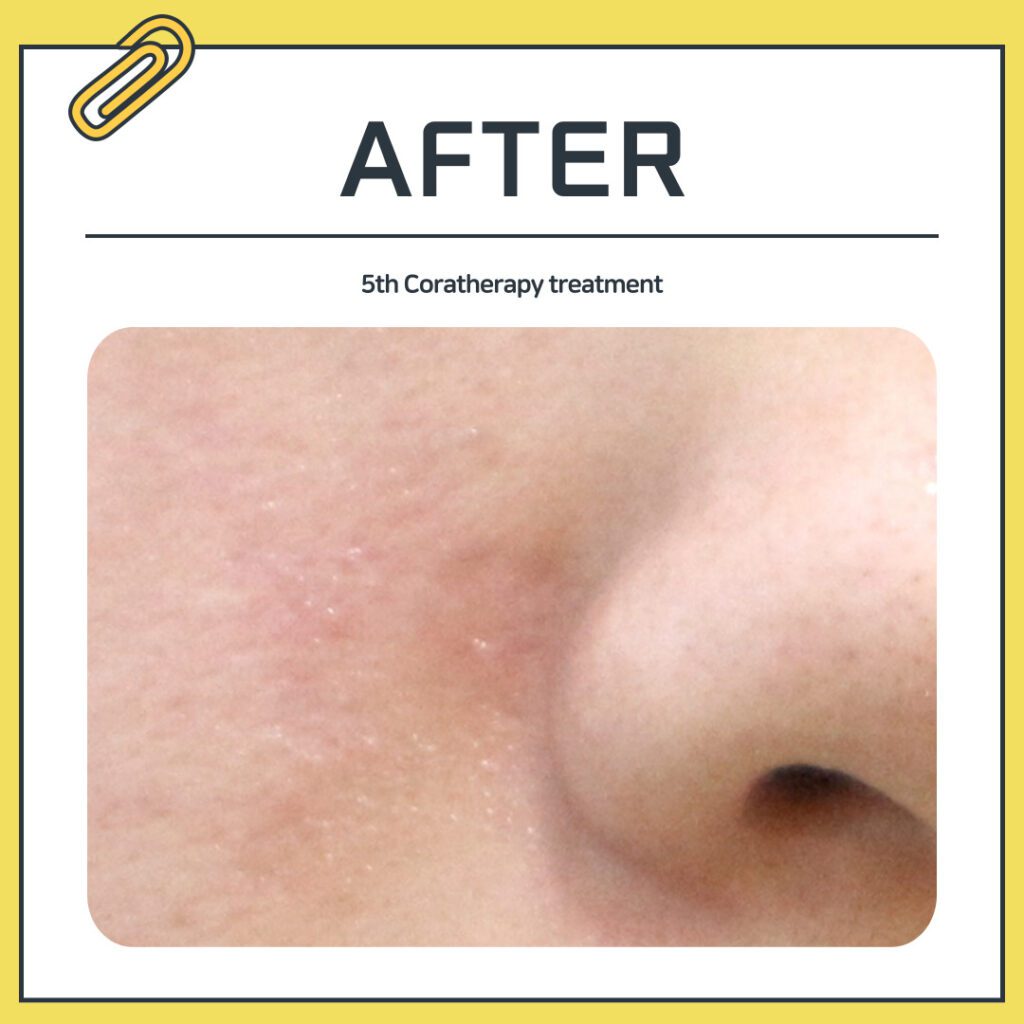
The appearance after the fifth session.
The height of the scar was almost completely filled, with only slight redness remaining.
The final session, the sixth session, focused on filling the remaining slight depression, concluding the treatment.
Although the initial plan was to complete 10 sessions, in this case,
the patient achieved recovery after just 6 sessions.
It was observed that the results could vary depending on the patient’s skin condition and regenerative ability.
Why does this variation occur for each individual?
This is due to the treatment principle of Coratherapy.

Coratherapy, developed in 2006 by Rodam Korean Medicine Clinic,
uses specially designed incision needles to release deep adhesions in the skin and induce the filling of regenerative substances in that space.
These regenerative substances promote collagen production, filling the scar area,
and fundamentally restore skin tissue by regenerating new skin from the dermal layer.
In other words, Coratherapy is a treatment that activates the skin’s regenerative ability to fundamentally restore the skin.
The number of sessions required may vary depending on the individual’s skin condition, regenerative ability, and the shape and type of scars.
Additionally, with thorough post-treatment care, you may experience faster-than-expected treatment effects.
Coratherapy is not just about covering scars but about enhancing the skin’s natural regenerative ability to aid fundamental recovery.
While the treatment process and results may differ depending on the patient’s skin condition and scar characteristics,
consistent treatment with experienced medical professionals and thorough aftercare can lead to results beyond expectations.
If you wish to recover from long-standing scars in a healthy way, like in this case, please visit Rodam anytime.
We will be with you on every step of your acne scar treatment journey. Thank you.