Acne Scar Treatment Effect of Coratherapy at Rodam Korean Medicine Clinic
Hello, this is Rodam Korean Medicine Clinic, the beginning of Coratherapy for scar removal.
Acne is more than just a simple skin trouble; the management during the recovery process can determine the future of your skin.
Especially, if proper treatment and care are not provided after acne subsides,
it can leave behind depressed scars on the skin, which are difficult to recover naturally.
Depressed scars are characterized by sunken areas on the skin’s surface,
making them more noticeable when exposed to light,
and this can increase stress related to appearance.
These scars occur when inflammation penetrates deep into the dermis layer, hindering skin regeneration,
or when the skin tissue is damaged due to external stimulation, such as squeezing acne with hands.
In this article, we will explore the various types of depressed acne scars that can result from acne,
and introduce Coratherapy, a treatment that helps promote skin tissue regeneration to improve these scars.

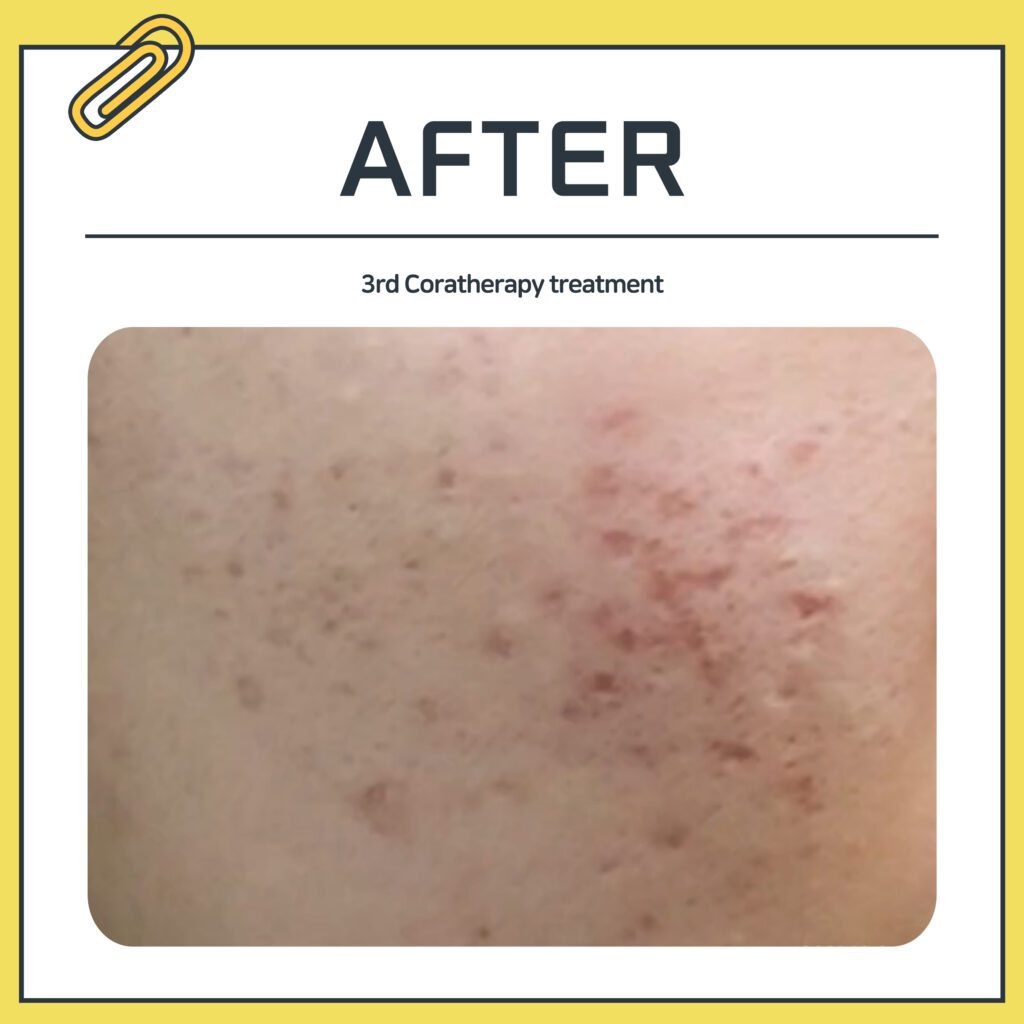
Case :: Complex Depressed Acne Scars on the Cheeks
History :: No Prior Treatment Experience
Report :: 10 Sessions of Coratherapy
First, acne scars can be broadly categorized into three types.
First, boxcar scars are rectangular-shaped depressed scars.
They have clear boundaries and cover a relatively large area.
Due to their depth, they easily create shadows.
Second, rolling scars appear as wavy, rolling depressions on the skin.
They have soft boundaries and shallow indentations, with shadows changing depending on the lighting.
Third, ice pick scars are narrow and deep, resembling small punctures made by an ice pick.
Though small in diameter, their depth makes them challenging to treat.
These types of depressed acne scars do not disappear simply with time.
Medical approaches are necessary for treating such scars, with options like lasers, fillers, and more.
Among these, Coratherapy is recommended for its effectiveness.
This case involved a combination of boxcar scars and ice pick scars.

When comparing the photos from the 3rd session to those after the 6th session,
you can see that the base of the scars has significantly risen.
Additionally, the boundaries of the scars have become much less distinct.

This is the appearance after completing 10 sessions of treatment.
Although redness remains, giving the scars a sense of depth,
the base has completely filled in, leaving the patient very satisfied.
As shown, Coratherapy is effective for treating depressed acne scars.
The effectiveness lies in the treatment principle of Coratherapy.
Coratherapy uses fine needles to separate the adhered tissue beneath the depressed area
and stimulate it to promote collagen production.
It works by stimulating the depressed area, much like tilling the soil, to encourage the formation of new skin tissue.
Since 2006, Rodam Korean Medicine Clinic has been performing Coratherapy,
using specially designed needles during the procedure to
sculpt and stimulate the scars.
This allows for a more natural connection with the surrounding normal skin
and helps regenerate the skin from within.
However, post-treatment care is also crucial.
To maximize the effects of Coratherapy, the following guidelines must be followed:
- Consistent Moisturization: The skin may become dry after treatment, so adequate moisturization is essential.
- Sun Protection: Newly regenerated skin is sensitive to UV rays, so apply sunscreen with a high SPF.
- Avoid Alcohol and Smoking: Alcohol and tobacco are major factors that hinder skin regeneration and should be avoided.
Acne scars cannot be resolved with surface-level treatments alone.
Coratherapy, which stimulates the dermis layer to induce skin regeneration,
achieves optimal results when combined with the skilled hands of an experienced Doctor.
By maintaining consistent lifestyle habits after treatment, you can significantly reduce concerns caused by scars.
If you are troubled by scars, please feel free to contact us anytime.
Rodam Korean Medicine Clinic is always here for you. Thank you.