Rodam Korean Medicine Clinic’s nose scar removal, coratherapy treatment
Hello, this is Rodam Korean Medicine Clinic, the beginning of Coratherapy for scar removal.
Indented scars are marks that occur during the process of skin tissue being damaged and recovering.
Especially scars on the face can lead not only to aesthetic concerns but also psychological burdens,
making many people consider treatment.
Among these, indented scars on the nose are one of the more challenging skin issues to treat.
The nose is located at the center of the face, drawing attention,
so scars on this area tend to stand out more.
Additionally, the nose has thin skin and many curves, making it difficult to approach during treatment,
and the surrounding tissue of the scar is often hardened, slowing the recovery process.
Indented scars, in particular, remain as sunken areas on the skin,
and they often do not heal naturally over time,
requiring treatments that fill the inside of the skin.
For these reasons, general laser treatments alone are often insufficient for significant improvement.
Therefore, today we would like to explain in detail, with actual photos,
how Coratherapy was used to treat indented scars on the nose that were difficult to improve with laser treatments alone,
and what effects it had on improving these scars.

Case :: Indented scar caused by laser treatment
History :: Experienced side effects from laser treatment, no other procedures attempted
Report :: 10 sessions of Coratherapy performed
The patient in today’s case had a scar on their nose caused by a severe bump,
and later developed an indented scar after receiving laser treatment.
This scar was particularly wide and had hardened edges, making it difficult to improve with general treatments.
Despite undergoing treatment, side effects led to an even larger scar,
causing the patient to lose trust in procedures.
Therefore, Rodam Korean Medicine Clinic explained to the patient that indented scars like theirs are treatable,
but depigmentation might be difficult to address.
We assured them that a customized treatment plan would be implemented.
After hearing this, the patient felt reassured and decided to proceed with treatment,
planning for 10 sessions of Coratherapy.
Before the procedure, the scar on the nose was clearly indented,
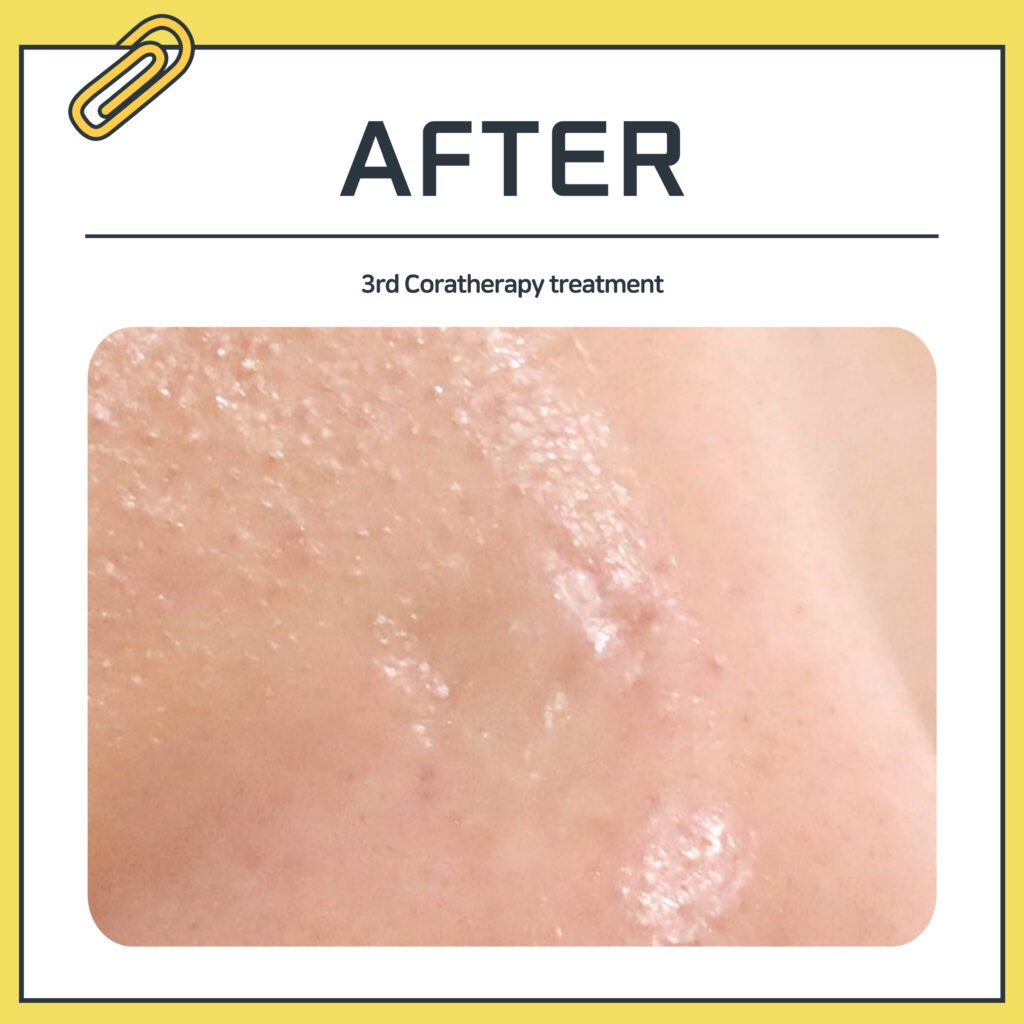
but as the sessions progressed, noticeable improvements were observed.
Changes began to appear after the third session,
though the scar was still prominent at that point.
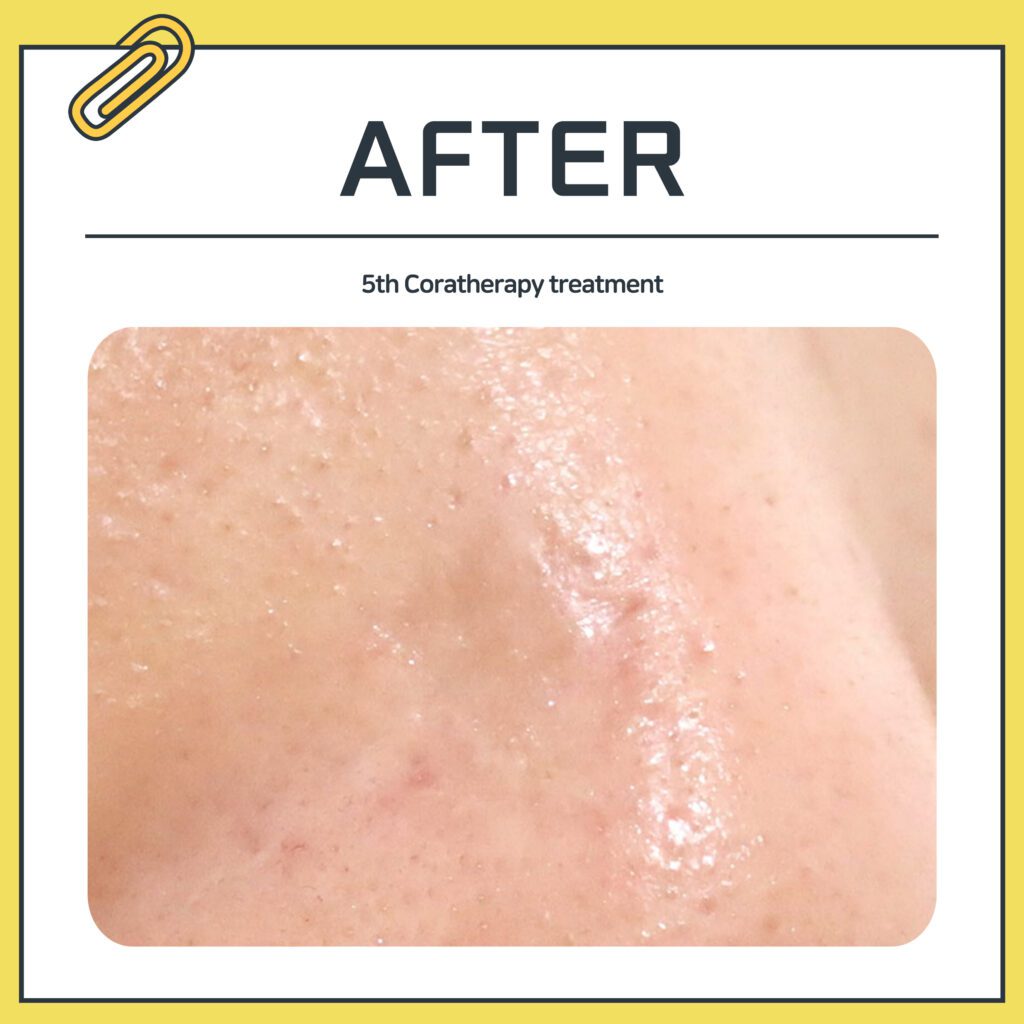
By the sixth session, more noticeable improvements were achieved.
Although some unevenness remained,
the overall appearance showed that the edges of the scar had softened,
and the sunken middle area had risen.
From the sixth session onward, the treatment plan was adjusted to focus on stimulating the remaining indented areas
while simultaneously refining the texture to allow the skin to recover naturally.
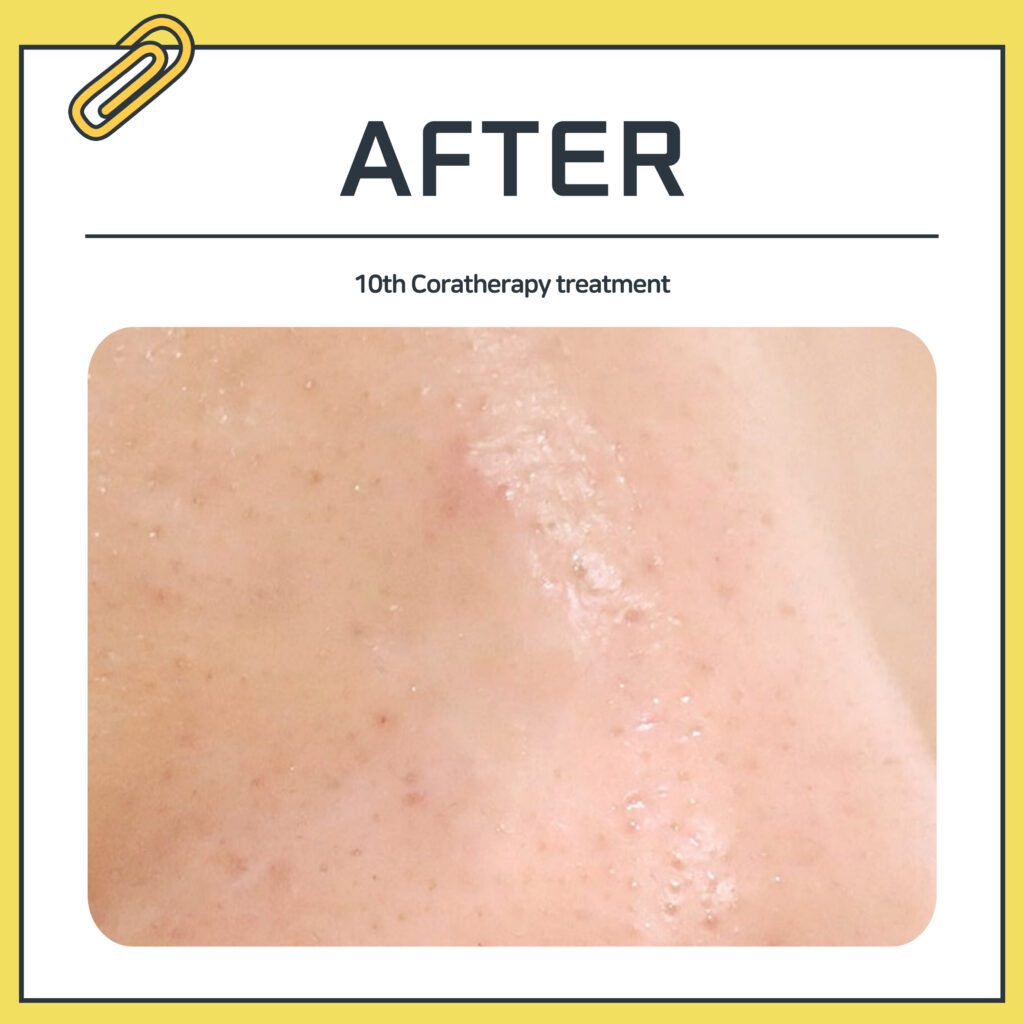
This is the appearance three months after completing 10 sessions of treatment.
The scar had significantly improved, returning to a natural skin condition.
Notably, the depigmentation issue that was a concern early on had also recovered.
This case demonstrates the importance of not just filling the scar,
but accurately understanding its characteristics and combining appropriate techniques
to create a customized treatment.
Indented scars caused by laser treatments are often difficult to treat,
but this case shows that the combination of Coratherapy and texture refinement can be an effective solution.
Especially, Rodam Korean Medicine Clinic’s Coratherapy has proven to be very effective for treating indented scars.
This is due to the treatment principles of Coratherapy.
Coratherapy at Rodam Korean Medicine Clinic,
a treatment for indented scars that began in 2006,
works by breaking the adhesions in the skin,
creating space that naturally increases blood supply.
This process attracts cells and growth factors necessary for skin regeneration,
activating fibroblasts and promoting the production of new skin tissues such as collagen and elastin.
Additionally, the specially designed needles used in Rodam Korean Medicine Clinic’s Coratherapy
allow for more precise stimulation of the boundaries between the scar and normal skin.
Scars treated in this way are naturally restored skin,
which means they do not sink back over time.
Because the treatment is performed with precision, as if sculpting by hand,
it is also effective for treating various types of indented scars,
such as acne scars, chickenpox/shingles scars, and surgical scars.
Of course, the condition of scars and treatment responses vary from patient to patient,
so it is difficult to expect the same results for all indented scars.
However, with an accurate diagnosis and a patient-specific treatment plan,
noticeable improvements can be anticipated.
We hope today’s post has helped alleviate some of your concerns about scars.
If you have any further questions, please feel free to contact us.
Rodam Korean Medicine Clinic is always here for you. Thank you.